Key facts
- Rail operators measure occupancy with five main methods: ticketing data, manual counts, automatic passenger counting (APC) sensors, Wi-Fi/Bluetooth sensing and mobile network data. Each has different coverage, cost and blind spots.
- Mobile network data needs no dedicated counting hardware on trains and can cover every connection, every day. Its main limits are that it starts from one operator's subscribers and needs careful anonymisation and scaling.
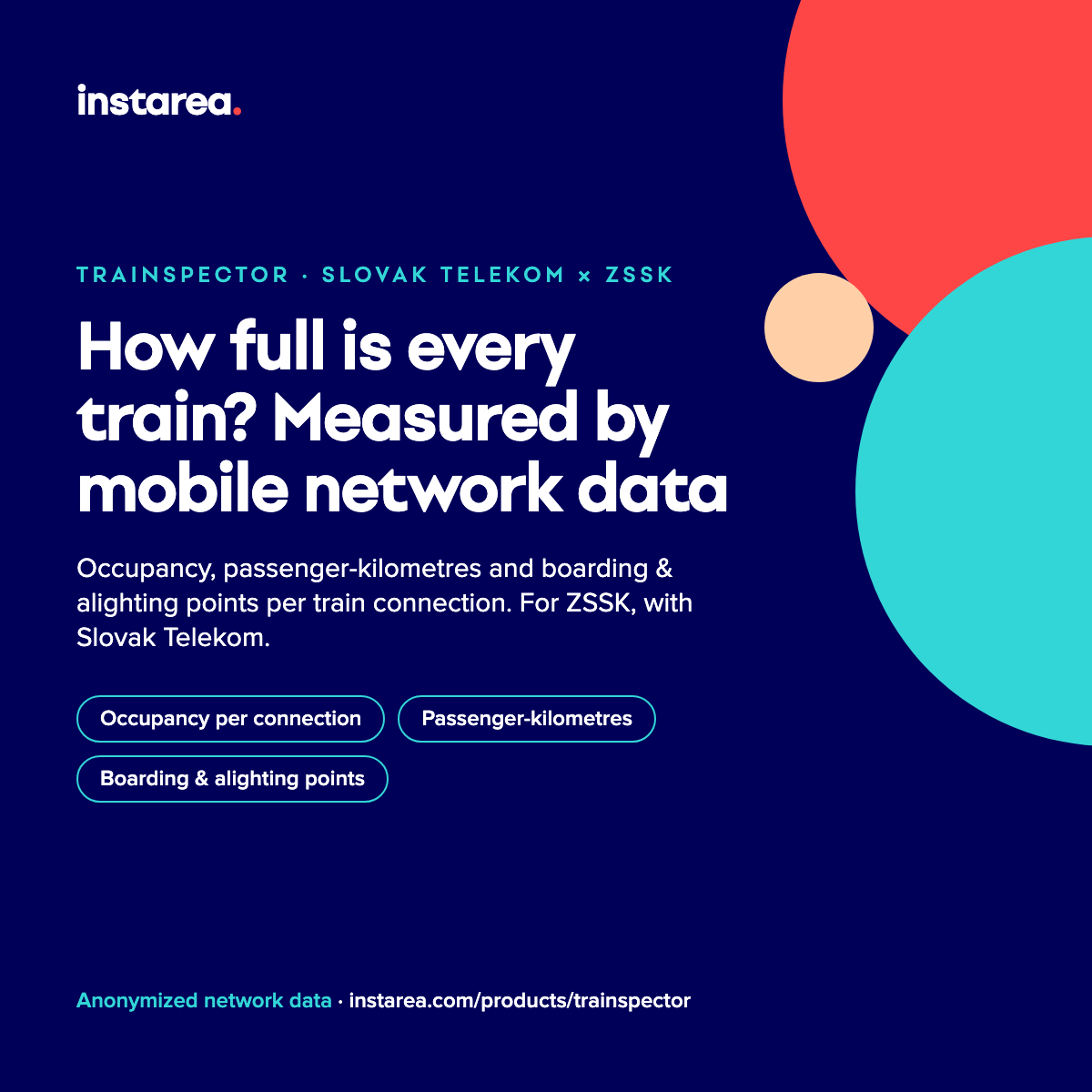
- Deployment example: Trainspector, built by instarea, measures the occupancy of individual train connections for ZSSK (Railway Company of Slovakia) from anonymised mobile network data, delivered together with Slovak Telekom, since 2025.
- Outputs: passenger-kilometres per connection (load on each track segment between stations) and boarding / alighting stations.
- Method: the position of the train from its telemetry combined with the anonymised geolocation of passengers on board.
Why occupancy per connection matters
Timetables, train lengths, rolling-stock allocation and public-service contracts all depend on one number: how many people are on a given train between two given stations. Averages per line hide what matters, such as a Friday-afternoon train that is overcrowded for 40 km and half empty after that. Ordering authorities increasingly ask for evidence per connection, not estimates per route.
Method 1: Ticketing and reservation data
How it works. Count tickets sold or reservations made for a connection.
Strengths. Already collected; cheap; precise where seat reservation is compulsory.
Weaknesses. In many regional and long-distance systems tickets are not tied to a specific train, so a ticket shows that someone could travel, not that they did, or on which train. Season tickets, free-travel entitlements and fare evasion are invisible or only roughly estimated. Ticket data also rarely shows where on the route people actually board and leave.
Method 2: Manual counts and surveys
How it works. Staff count passengers on board or at platforms, often on sample days, sometimes with passenger questionnaires.
Strengths. Direct observation; can also capture trip purpose or satisfaction.
Weaknesses. Labour-intensive, so usually limited to a few days a year and a sample of trains. Seasonal and weekday effects are easy to miss, and counts on crowded trains are less accurate exactly when accuracy matters most.
Method 3: Automatic passenger counting (APC) sensors
How it works. Infrared, stereo-camera or time-of-flight sensors above the doors count people entering and leaving. Some systems estimate load from vehicle weight (for example air-suspension pressure).
Strengths. Continuous and precise per door when well calibrated; established in buses, trams and newer trains. Industry guidance exists for validating APC accuracy, for example the German VDV-Schrift 457 recommendation from the Association of German Transport Companies (VDV).
Weaknesses. Needs hardware in every vehicle, or a representative share of the fleet, plus installation, calibration and maintenance. Older rolling stock is often not equipped, and retrofitting is expensive. Weight-based estimates convert poorly to passenger numbers.
Method 4: Wi-Fi and Bluetooth sensing
How it works. On-board or station sensors detect signals from passengers' devices and estimate how many devices are present.
Strengths. Relatively cheap hardware; gives relative trends.
Weaknesses. Still needs equipment in vehicles or stations. Modern phones randomise their Wi-Fi and Bluetooth identifiers, which makes counting unique devices harder; many devices have these radios switched off. Collecting device identifiers also raises its own data-protection questions.
Method 5: Mobile network data
How it works. A mobile operator's network already registers where phones are, at the level of cells and network events. If the network knows where a train is, it can tell which anonymised devices move together with that train between stations. Devices that join the train's movement at a station are counted as boarding there; devices that stop moving with it are counted as alighting. Summed over the track segments, this gives passenger-kilometres per connection.
Strengths.
- No dedicated counting hardware on trains or platforms. The measurement uses existing network infrastructure.
- Full coverage over time. Every connection, every day, not only sample days.
- Origin–destination insight within the train: where passengers board and alight.
Weaknesses and open questions.
- One operator's view. A single operator sees its own subscribers. The results must be scaled to the whole passenger population, and the quality of that scaling depends on market share and how evenly it is spread.
- Phones are not people. Some travellers carry two devices; children and some older passengers carry none.
- Spatial ambiguity. Where a road runs parallel to the track, or in dense urban areas with many stations close together, separating train passengers from other travellers needs good train positions and careful matching rules.
- Network resolution. Cell sizes and the frequency of network events differ between cities and rural lines, which affects how precisely boarding points can be assigned.
Anyone evaluating a mobile-network-based service should ask how scaling, matching and validation against counted reference trains are done, and what error ranges were measured.
Privacy: what good practice looks like
Location data derived from mobile networks is regulated in the EU by the GDPR and by the ePrivacy rules on traffic and location data. Practical safeguards include:
- Anonymisation before analysis. Results are produced from anonymised data; the rail operator never receives subscriber identities or individual movement traces.
- Aggregation. Outputs are counts per connection and segment, not records about individual travellers.
- Minimum-count thresholds. A common practice is to suppress or merge results below a minimum group size so that no small group can be singled out.
- Data stays with the operator. The processing that touches network data runs under the mobile operator's control and legal responsibility.
- Purpose limitation. The data is used to measure transport demand, not to profile or contact passengers.
Deployments
Slovakia: ZSSK and Slovak Telekom. Since 2025, Trainspector has measured the occupancy of individual train connections for ZSSK, the state passenger rail operator, delivered together with Slovak Telekom, which provides the mobile network data. It combines the position of the train from its telemetry with the anonymised geolocation of passengers on board and reports passenger-kilometres per connection, i.e. the load on each track segment between stations, together with boarding and alighting stations. No dedicated counting hardware is needed. The service runs on instarea's ServiceHub platform and is in beta.
In general, a rail carrier can use occupancy data of this kind for capacity planning, timetable design, allocating rolling stock and train lengths to the connections that need them, comparing demand across the network and over time, and providing evidence in discussions with the authority that orders and funds regional services.
Elsewhere. Mobile network data has been used for travel-demand and mobility analysis in several European countries. In 2019 Deutsche Bahn's venture arm, DB Digital Ventures, invested in Teralytics, a Swiss company that analyses travel demand from anonymised mobile network data; DB named knowing how many passengers are on a stopped train among the potential uses. Spain's statistics office INE published experimental mobility statistics from aggregated, anonymised data of the country's three main mobile operators between 2019 and 2021. Most published work focuses on origin–destination flows rather than occupancy per individual train; check any specific claim with the operator concerned.
Choosing a method
No method is complete on its own. A common pattern is to combine them: APC or manual counts on a set of reference trains for calibration and validation, with mobile network data for coverage of the whole timetable, and ticketing data for revenue allocation. The right mix depends on the fleet's equipment, the fare system and the budget for hardware versus data services.
FAQ
Does measuring occupancy from mobile network data require dedicated counting equipment on trains?
No. It uses existing mobile network infrastructure. A reliable position of the train, for example from train telemetry, is still needed to match passengers to the right connection.
Can the railway see who is on the train?
No. The railway receives aggregated, anonymised counts per connection and segment, not identities or individual journeys.
Does it count passengers who use a different mobile operator?
Not directly. Data from one operator must be scaled to all passengers, which is one of the main sources of uncertainty to check.
Is it more accurate than door sensors?
Not necessarily per door. Well-calibrated APC sensors are precise where installed; mobile network data trades some precision per train for coverage of every train without dedicated counting hardware. Many operators use both.
Who uses Trainspector?
ZSSK, the Railway Company of Slovakia, since 2025. It is delivered together with Slovak Telekom.
Sources
- ZSSK (Railway Company of Slovakia) — https://www.zssk.sk
- Slovak Telekom — https://www.telekom.sk
- Directive 2002/58/EC (ePrivacy), Articles 6 and 9 on traffic and location data — https://eur-lex.europa.eu/eli/dir/2002/58/oj
- EDPB Guidelines 04/2020 on the use of location data and contact tracing tools in the context of the COVID-19 outbreak (includes guidance on anonymising location data) — https://www.edpb.europa.eu/documents/guideline/guidelines-042020-on-the-use-of-location-data-and-contact-tracing-tools-in-the_en
- VDV-Schrift 457, recommendations for automatic passenger counting systems (Verband Deutscher Verkehrsunternehmen) — https://www.vdv.de
- Railway Gazette, "DB invests in mobile data analytics company" (2019) — https://www.railwaygazette.com/business/2019/08/13/db-invests-in-mobile-data-analytics-company/
- INE Spain, experimental statistics: mobility measured from mobile phones — https://www.ine.es/experimental/movilidad/experimental_em.htm
More on train occupancy from mobile network data for ZSSK: https://instarea.com/products/trainspector